

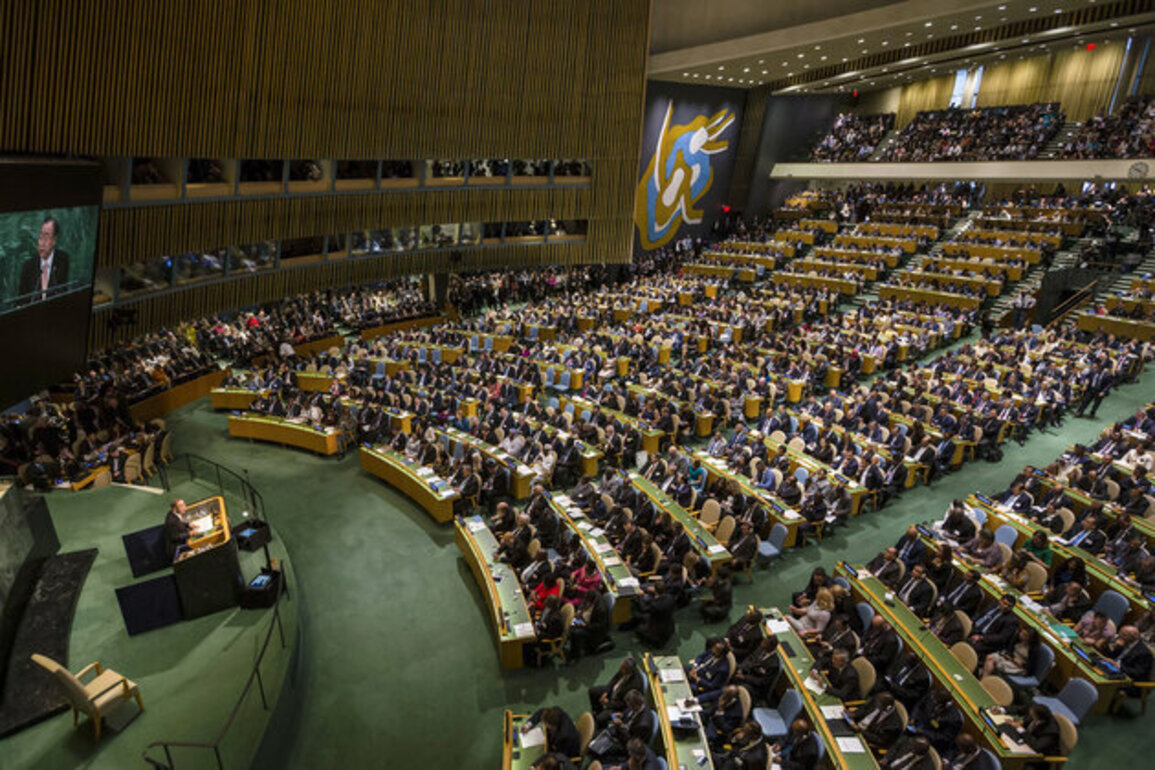
One year ago, the UN General Assembly demanded that Israel must end its occupation of the Palestinian Territories within twelve months.
by Medea Benjamin and Nicolas J. S. Davies
The General Assemblyvoted, by 124 votes to 14, with 43 abstentions, for a strongresolutionthat not only demanded an end to the occupation within a year, but called on all countries to refrain from trade involving Israeli settlements and from transfers of weapons where there are reasonable grounds to suspect that they may be used in the Occupied Palestinian Territory.
The General Assembly was meeting on September 18th, 2024, in an Emergency Special Session, invoking the Uniting For Peace principle to act where the UN Security Council has failed to do so. The General Assembly had asked the International Court of Justice (ICJ) to rule on the legality of the Israeli occupation and the legal consequences arising from it, and the new resolution was triggered by the courtsruling, on July 19th, 2024 that the Israeli occupation is unlawful and must end as rapidly as possible.
A year later, Israel has failed to comply with any of the demands of the 124 states. On the contrary. It has escalated its genocide in Gaza by cutting off nearly all food, medicine and humanitarian assistance, launching relentless bombardments, expanding ground incursions, and displacing virtually the entire population. All over the world, people are calling on leaders and politicians to do whatever it takes to put a stop to this holocaust before it goes any further.
As world leaders gather again in New York for another UN General Assembly beginning on September 9th, how will they respond to Israels ever-escalating genocide and continued occupation and expansion of settlements in the West Bank and Jerusalem? Grassroots political pressure is building on all of them to turn the strong words in ICJ rulings and UN resolutions into meaningful action to end what the vast majority of the world recognizes as the most flagrant genocide of our time.
Countries have taken individual actions to cut off trade with Israel and cancel weapons contracts. Turkeyannounceda total trade boycott on August 29th, and closed its airspace to Israeli planes and its ports to Israeli ships. Twelve members of the Hague Group, formed to challenge Israeli impunity, have formally committed to banning arms transfers and blocking military-related shipments at their ports.Sweden and the Netherlandshave urgedthe EU to adopt sanctions on Israel, including suspending the EU-Israel trade deal.
But most of the 124 countries that voted to demand an end to the occupation have done very little to enforce those demands. If they fail to enforce them now, they will only confirm Israels presumption that its corrupt influence on U.S. politics still ensures blanket impunity for systematic war crimes.
In response to this unconscionable state of affairs, Palestines UN Representative has formallyaskedthe UN to authorize an international militaryprotection forcefor Gaza to help with the delivery of humanitarian aid and protect civilians. So has the largest coalition of Palestinian NGOs, PNGO, as well as pro-Palestine groups andleaderssuch as Irelands President Michael D. Higgins. Theres agrowing global movementcalling for the UN General Assembly to take up this request in another Emergency Special Session when it meets this month. That would be well within the authority of the General Assembly in a case like this, where the Security Council has been hijacked by the U.S. abuse of its veto power.
Whether or not this initiative for a protective force succeeds, the truth is that the governments of the world already have countless ways to support Palestinethey simply need to muster the political will to act. Israel is a small country that depends on imports from countries all over the world. It hasdiversifiedsources for many essential products, and, although the United States supplies 70% of its weapons imports, many othercountriesalso supply weapons and critical parts of its infernal war machine. Israels dependence on complicated international supply chains is the weakest link in its presumption that it can thumb its nose at the world and kill with impunity.
If the large majority of countries that have already voted for an end to the occupation are ready to back theirwordsand their votes with coordinated action, a UN-led trade boycott,divestmentcampaign and arms embargo can put enormous pressure on Israel to end its genocide and starvation of Gaza, and its occupation of Palestine. With full participation by enough countries, Israels position could quickly become unsustainable.
Two years into a genocide, it is shameful that the worlds governments havent already done this, and that their people have to plead, protest and push them into action through a dense fog of spin and propaganda, while leaders mouth the right words yet keepdoingthe wrong things.
Many people compare the problem the world faces in Israel to the crisis over apartheid in South Africa. The similarity lies not only in their racism, but also in the western countries shameful complicity in their human rights abuses and lack of concern for the lives of their victims. It is surely nocoincidencethat the United States, with its own history of genocide, slavery and apartheid, acted as the main diplomaticsupporterand militarysupplierof apartheid South Africa, and now of Israel.
But it took over30 years, from the first UN arms embargo and oil sanctions in 1963 to the final lifting of UN sanctions in 1994, before UN action helped bring down the apartheid regime in South Africa. It was not until 1977 that the UN even made its arms embargo binding on all members. In the case of Israel and Palestine, the world cannot wait 30 years for its actions to have an impact. What will be left to salvage of Palestine if the UN can only counter Israels genocide and Americas bombs with endless court rulings, resolutions and declarations, but no decisive action?
One initiative that will be debated and voted on in the General Assembly is the one advanced by France and Saudi Arabia. In July they hosted a high-levelUN conferenceon the Peaceful Settlement of the Question of Palestine and the implementation of the Two State Solution. But its agenda is weak and it avoids any strong action to pressure Israel to end the genocide or the occupation.
The first steps the declaration calls for are a ceasefire in Gaza, the restoration of the Palestinian Authoritys control of Gaza, and then the deployment of an international military stabilization force. But Israel has already rejected the first two steps, and critics warn that a stabilization force would mean foreign troops deployed in Gaza, not to protect Palestinians from Israeli bombs and bulldozers, but to police them, contain resistance, and reinforce Israeli demands.
Moreover, the declaration contains no enforcement mechanism. Instead, it offers only carrotspromises of recognition, trade, and arms dealswhile Israel pays no price for continuing its crimes.
And while the declaration could pave the way for more Western countries to join the 147 countries that already recognize Palestine as an independent state, without concrete pressure on Israel to agree to a ceasefire in Gaza and end the occupation, such recognition risks being symbolic at bestand, at worst, may embolden Israel to accelerate its campaign of mass killing, settlement expansion, and annexation before the world can act.
What is urgently needed is for the General Assembly to hold an Emergency Special Session to vote on a UN protection force, as well as a UN-led arms embargo, trade boycott and divestment from Israel, conditioned on ending the genocide in Gaza and the post-1967 occupation of the Occupied Palestinian Territories.
The arms embargo and economic measures against Israel should be binding on all UN members, with the full support of the UN secretariat, which can provide staff to organize and supervise them, in coordination with UN members. China, the largest supplier of Israeliimports, and Turkey, which was the third largest before it cut off trade with Israel, should both be ready to take leadership roles in a UN boycott and arms embargo. The European Union collectively does even more trade with Israel than China, and has failed to unite against the genocide, but strong UN leadership could help Europe to overcome its divisions and join the campaign.
As for the United States, its role in this crisis, under Biden and now under Trump, is to encourage Israels crimes, provide unlimited weapons, veto every Security Council resolution, and oppose every international attempt to end the slaughter. Even asmajoritiesof ordinary Americans now side with the Palestinians and oppose U.S. military support for Israel, the oligarchy that rules America is as guilty of genocide as Israel itself. As the world comes together to confront Israels crimes, it will also have to confront the reality that Israel is not acting alone, but in partnership with the United States of America.
Aggressors and bullies get their way by dividing their enemies and picking them off one at a time, as the world has seen the European colonial powers and now the United States do for centuries. What every aggressor or bully fears most is united opposition and resistance.
Israel and the U.S. currently apply huge politicalpressureagainst countries and institutions that take action to boycott, sanction or divest from Israel, as Norway has by its decision to divest its sovereign wealth fund fromCaterpillarfor supplying bulldozers to demolish homes in Palestine. In a world that is truly united to end Israels genocide, threats of U.S. and Israeli retaliation would isolate the United States and Israel more than those they target.
Recent UN General Assemblies have heard many speeches lamenting the UNs failure to fulfill its most vital purpose, to ensure peace and security for all, and how the veto power of the five permanent members (P5) of the Security Council prevents the UN from tackling the worlds most serious problems. If, at this years UN General Assembly, the world can come together to confront the holocaust of our time in Gaza, this could mark the birth of a reenergized and newly united UNone finally capable of fulfilling its intended role in building a peaceful, sustainable, multipolar world.
Medea Benjamin and Nicolas J. S. Davies are the authors ofWar in Ukraine: Making Sense of a Senseless Conflict,with a new, updated and revised edition recentlypublished by OR Books.
Medea Benjamin is the cofounder ofCODEPINK for Peace, and the author of several books, includingInside Iran: The Real History and Politics of the Islamic Republic of Iran.
Nicolas J. S. Davies is an independent journalist, a researcher for CODEPINK and the author ofBlood On Our Hands: the American Invasion and Destruction of Iraq.
Codepink